

WHAT NOBODY TELLS YOU…
Is your brand about to become invisible online?
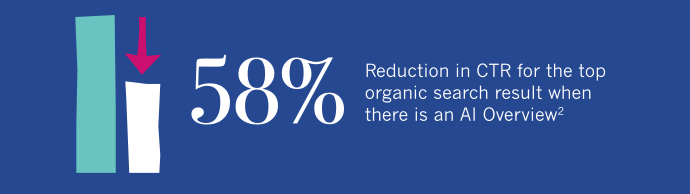
Now they see you, now they don’t. With nearly 60% of Google searches ending without a click,1 fewer users are finding their way to brand sites today. The reason seems obvious: AI Overviews are preempting further exploration by providing fast, easy answers. What’s less understood is what you can do about it.
The answer lies in restructuring, rewriting and repackaging your content specifically for consumption by AI, such as ChatGPT or Google’s AI Overviews (Gemini), so they quote and mention your brand. Here are the secrets nobody tells you:
Nobody tells you… keywords aren’t so key anymore
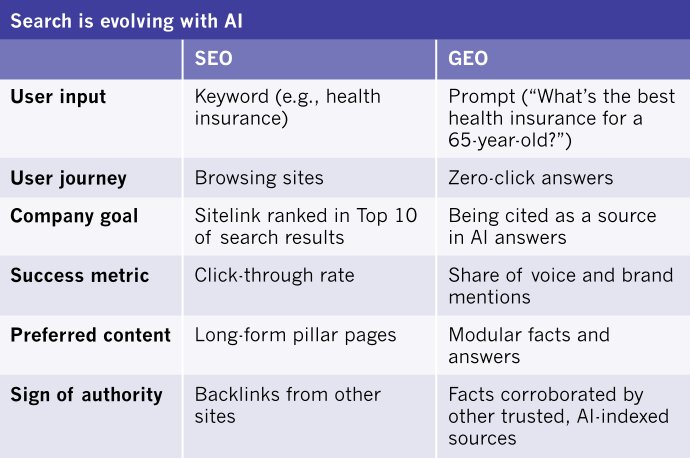
Today, we’re seeing a shift from SEO to GEO (generative engine optimization), from entering search terms to entering questions. Cramming keywords into content – to rank high in search results – is no longer enough. GEO is focused on what users are asking AI and who’s best equipped to answer them.
To help make the case that it’s you, try auditing your pages to ensure they explicitly answer a number of core user prompts.
Nobody tells you… “extractability” beats eloquence every time
Sorry, copywriters (and other fans of the written word). While SEO might reward a well-crafted, long-form narrative, GEO is less appreciative. AI models don’t “read” your site – they ingest it in chunks looking for immediate answers to user questions. A few tips:
- If you can’t summarize your main idea in a 40–80 word block that stands alone, you’re invisible. So get to the point fast.
- Pronouns and ambiguity can confuse AI. When you say, “This tool reduces latency,” AI may wonder, “What tool?” Always providing context, like the brand name of the tool, helps.
- Forgoing prose in favor of bullets, numbered steps or tables also increases your chances of being cited by AI.
Nobody tells you… if you’re not an authority, you’re nobody
While SEO is obsessed with repetition of keywords, GEO fixates on whether terms relate in a way that indicates subject mastery. To put it another way, AI doesn’t care how often you mention “target date funds” – it just wants to know you’re a topic authority on the entire ecosystem of retirement plans. Our strategy?
- Clearly define how your brand, product and category interconnect, using unwavering consistency so AI can build a stable “mental model” of your business.
- Prove your expertise by using “neighborhood words” that surround a topic, not just a primary keyword.
- Host a comprehensive technical glossary of industry terms to position your site as a foundational source of truth.
Nobody tells you… AI really wants you to prove it
AI engines have a problem: they hallucinate. To compensate, they’re now hyper-vigilant about filtering out fluff. Vague marketing-speak, like “world-class service,” doesn’t give AI confidence to quote you. What AI wants is evidence. Facts. Statistics. You can provide it by beefing up your E-E-A-T (Experience, Expertise, Authoritativeness, Trust).
- Start by swapping out adjectives for data – instead of saying your software is fast, say how fast (“reduces processing time by 22%”).
- Cite your original data and research to satisfy AI’s thirst for what’s new. They’re GEO gold because they can’t be found elsewhere.
- Reinforce credibility by including verified author bios with your posts.
Nobody tells you… you don’t have to follow ALL these rules
You may have noticed we didn’t (e.g., no author bio because we want to emphasize our collaborative approach). In the same way writing for SEO can result in lengthy content people don’t read, writing for GEO can create other compromises. How much you optimize for it is a strategic decision you’ll have to make after weighing all your objectives.
Want to know more?
We can help ensure your brand doesn’t pull a disappearing act online because of AI. For guidance on maintaining your visibility, call us today ›
1 Forbes, March 2, 2026
2 Ahrefs, February 4, 2026

 See what they have to say